
Table of ContentsHelena Petrovna Blavatsky
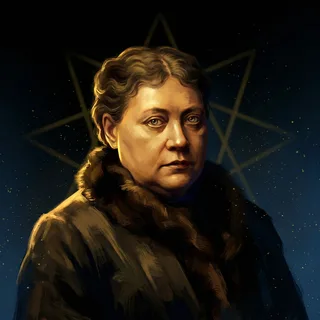
Helena Petrovna Blavatsky
Last updated: September 4, 2026
The audacious mystic who broke open the Western mind to Eastern wisdom and created the blueprint for modern spiritual seeking.
Lived
1831 – 1891
Nationality
Russian
Tradition
Theosophy
Known For
Isis Unveiled (1877), The Secret Doctrine (1888), The Key to Theosophy (1889)
Tone
Balanced3.5 / 6
Describes root races, cosmic cycles, and sorcery alongside brotherhood and evolution. Unflinching but evolutionary-optimistic.
Why Blavatsky Matters
Blavatsky didn't just introduce Eastern ideas to the West: she weaponized them against religious orthodoxy and scientific materialism simultaneously. Her synthesis of ancient wisdom traditions with evolutionary theory created a new category of spiritual thought that influenced everyone from Rudolf Steiner to the New Age movement. She proved that spiritual authority could come from direct experience rather than institutional sanction, making her the patron saint of independent seekers everywhere.
Start Here: The Reading Path
- The Key to Theosophy1889Start here for Blavatsky's clearest explanation of Theosophical principles without the overwhelming erudition of her major works. She wrote this specifically to answer critics and clarify misunderstandings.Focus on the chapters on karma and reincarnation to understand her core teaching method.
- Isis Unveiled1877Her first major work and still her most readable, this two-volume critique of both religious dogma and scientific materialism reveals her method of using ancient wisdom to solve modern problems.Don't try to read cover to cover. Use the index to explore topics that interest you.
- The Secret Doctrine1888The magnum opus that established Theosophy as a complete worldview. Dense, difficult, but containing her most original contributions to cosmology and anthropology.
Core Ideas in 60 Seconds
- There is no religion higher than truthTruth transcends all sectarian boundaries and can be found in the common core of all wisdom traditions.Truth
- The septenary constitution of man reveals our multidimensional natureHumans exist simultaneously on seven planes of being, from physical to spiritual, explaining both our limitations and our potential.Astral Body
- Root races evolve both physically and spiritually through cosmic cyclesHumanity develops through distinct evolutionary phases, each developing different capacities of consciousness.Reincarnation
- Mahatmas are living proof of human spiritual potentialAdvanced beings who have completed human evolution serve as teachers and guardians of ancient wisdom.Illumination
- Ancient wisdom underlies all genuine religion and scienceA perennial philosophy connects all authentic spiritual and scientific discoveries across cultures and centuries.Theosophy
Major Works
| Title | Year | What It Teaches | Best For |
|---|---|---|---|
| Isis Unveiled | 1877 | Ancient wisdom provides the key to understanding both religious mysteries and scientific phenomena | Beginners wanting to understand her critique of materialism and orthodoxy |
| The Secret Doctrine | 1888 | A complete cosmology and anthropology based on the synthesis of world scriptures and occult tradition | Advanced readers prepared for deep study of metaphysical principles |
| The Key to Theosophy | 1889 | Clear exposition of Theosophical teachings on karma, reincarnation, and the path of spiritual development | Anyone seeking a systematic introduction to Theosophical philosophy |
| The Theosophical Glossary | 1892 | Definitions of Sanskrit, Hebrew, and occult terms essential for understanding esoteric literature | Students and practitioners needing reference material for spiritual terminology |
Lineage & Influence
Influenced By
Blavatsky claimed direct instruction from Mahatmas in Tibet, but her work clearly synthesizes Paracelsus's correspondence principles, Swedenborg's spiritual planes, and Eliphas Levi's occult methodology with Eastern philosophy she encountered during her travels in India and Tibet.
Influenced
Her impact was immediate and massive: Annie Besant became Theosophy's greatest popularizer, Rudolf Steiner developed Anthroposophy from Theosophical foundations, and Alice Bailey channeled the Tibetan Master tradition she established.
Parallel Thinkers
While Eliphas Levi was reviving Western occultism in France, Blavatsky was creating something entirely new by wedding Eastern metaphysics to Western evolutionary thought, making her synthesis far more comprehensive than contemporary occultists.
The Story
Helena Petrovna Blavatsky lived as if the conventional world were a prison to be escaped. Born into Russian aristocracy, she spent her youth fleeing marriage and social expectations, wandering from Egypt to India to Tibet, collecting initiations and esoteric knowledge like others collected souvenirs. Her real life began in 1873 when she arrived in New York with almost nothing but an extraordinary claim: that she had been trained by advanced spiritual beings called Mahatmas who had commissioned her to bring ancient wisdom to the modern world. Within two years, she had co-founded the Theosophical Society and begun writing Isis Unveiled, a devastating critique of both religious dogma and scientific materialism that introduced Americans to karma, reincarnation, and the possibility that truth might be found in Hindu and Buddhist texts rather than Christian ones. Her masterwork, The Secret Doctrine, attempted nothing less than a complete cosmology that would reconcile Darwin with the Vedas, but her real achievement was simpler and more revolutionary: she convinced Westerners that spiritual authority belonged to anyone bold enough to claim it, not just to priests and professors.
In Their Own Words
There is no religion higher than truth.
The Secret Doctrine
The Universe is worked and guided from within outwards.
The Secret Doctrine
It is an occult law moreover, that no man can rise superior to his individual failings without lifting, be it ever so little, the whole body of which he is an integral part.
The Key to Theosophy
Frequently Asked Questions
Was Helena Blavatsky a fraud or genuine mystic?
Scholarly consensus suggests she fabricated some phenomena and exaggerated her credentials, but her synthesis of Eastern and Western thought was genuinely original and influential. Whether her sources were Mahatmas or libraries, her ideas transformed Western spirituality.
What is the difference between Theosophy and other spiritual movements?
Theosophy uniquely combines evolutionary science with ancient wisdom traditions, emphasizing both individual development and cosmic cycles. Unlike Christian esotericism, it fully embraces reincarnation and karma as natural laws.
Do I need to believe in Mahatmas to study Theosophy?
Not at all. Blavatsky's philosophical synthesis of consciousness, evolution, and spiritual development stands on its own merits regardless of its claimed sources.
Is Blavatsky's racial theory problematic?
Yes, her root race doctrine reflects 19th-century racial hierarchies that are scientifically unfounded and ethically objectionable. Modern students typically focus on her psychological and metaphysical insights while rejecting the racial components.
Explore Further
The Master Key Experience
The books teach the law.
The Experience trains it.
A 24-week guided journey through the laws of mind: weekly gates, lessons drawn from the texts in this library, and a living companion that remembers you.
Begin the ExperienceFree · Begin without an account