
Table of ContentsEmanuel Swedenborg
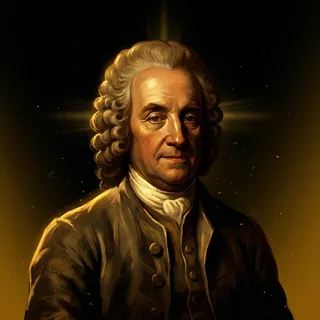
Emanuel Swedenborg
Last updated: September 4, 2026
The scientist-turned-visionary who mapped the invisible architecture connecting heaven and earth, creating the theological foundation for modern mind-power movements.
Lived
1688 – 1772
Nationality
Swedish
Tradition
Mystical Christianity
Known For
Heaven and Hell (1758), Divine Love and Wisdom (1763), Arcana Coelestia (1749-1756)
Tone
Balanced3.5 / 6
Firsthand descriptions of heavens and hells. Moral seriousness throughout, but hell is very real.
Why Swedenborg Matters
Swedenborg revolutionized Western spirituality by providing a systematic, scientific approach to mystical experience. His doctrine of correspondences gave metaphysical thinkers like Warren Felt Evans and the entire New Thought movement their core principle: that spiritual and material realms operate by identical laws. Unlike other mystics who spoke in symbols, Swedenborg wrote detailed spiritual geography based on claimed direct experience, making the invisible world as concrete as anatomy.
Start Here: The Reading Path
- Heaven and Hell1758The perfect introduction to Swedenborg's unique blend of mystical experience and systematic theology. This work maps the spiritual world with scientific precision, showing how consciousness creates reality in the afterlife.Focus on sections 104-115 on correspondences to understand the foundation of later metaphysical thought.
- Divine Love and Wisdom1763Swedenborg's most philosophical work, establishing the metaphysical principles that would later influence New Thought. Essential for understanding how divine energy flows into material reality through degrees.Pay special attention to the doctrine of 'influx' which anticipates modern ideas about mental causation.
Core Ideas in 60 Seconds
- There is nothing in the natural world that does not have something corresponding to it in the spiritual worldEvery material thing is a symbol and effect of a spiritual cause, making the universe a vast system of interconnected meanings.Correspondence Law of
- All reality flows from the divine through discrete degrees, not continuous gradationsDivine energy steps down through distinct levels of being, explaining how infinite spirit becomes finite matter.Emanation
- Heaven and hell are states of mind that humans create through their ruling lovesThe afterlife is not imposed by God but self-created through the consciousness patterns established in physical life.Consciousness
- The divine influx operates through the human mind to create external conditionsGod works through human thought and will to manifest reality, making consciousness the bridge between spiritual and material worlds.Divine Mind
Major Works
| Title | Year | What It Teaches | Best For |
|---|---|---|---|
| Arcana Coelestia | 1756 | A verse-by-verse spiritual interpretation of Genesis and Exodus revealing the inner meaning of scripture through correspondences | Advanced readers interested in scriptural symbolism and systematic theology |
| Heaven and Hell | 1758 | A detailed description of the spiritual world based on claimed direct experience over many years | Beginners seeking to understand Swedenborg's unique approach to mystical experience |
| Divine Love and Wisdom | 1763 | The metaphysical principles governing the relationship between infinite spirit and finite creation | Practitioners interested in the philosophical foundations of spiritual causation |
| Divine Providence | 1764 | How divine wisdom operates through apparent freedom while respecting human choice and responsibility | Advanced readers exploring the relationship between divine will and human agency |
Lineage & Influence
Influenced By
Swedenborg emerged from Lutheran orthodoxy but was shaped by his extensive scientific training and claimed direct spiritual experiences beginning in his mid-fifties. His systematic approach reflects his background as a mining engineer and natural philosopher.
Influenced
Warren Felt Evans directly adapted Swedenborg's correspondence doctrine for mental healing, making it the cornerstone of New Thought. Ralph Waldo Emerson drew heavily on Swedenborgian ideas about spiritual-material correspondence. The entire metaphysical movement owes its fundamental premise to Swedenborg's systematic theology.
Parallel Thinkers
Unlike his contemporary Paracelsus who worked through alchemical symbolism, Swedenborg presented mystical experience as reportable fact. Rudolf Steiner later developed similar detailed maps of spiritual worlds but through anthroposophical rather than Christian theological frameworks.
The Story
Emanuel Swedenborg lived two distinct lives. For the first half-century, he was Sweden's leading scientist and inventor, serving as assessor of the Royal College of Mines and writing groundbreaking works on metallurgy, anatomy, and natural philosophy. Then in 1744, at age 56, he experienced a dramatic spiritual awakening that redirected his entire focus to mapping the invisible world he claimed now opened before him. For the remaining 28 years of his life, Swedenborg methodically recorded his alleged conversations with angels and exploration of heaven and hell, producing over 30 volumes of systematic theology based on direct spiritual experience. His unique combination of scientific rigor and mystical vision created a new form of revelational theology that would profoundly influence American transcendentalism and the entire New Thought movement. He died in London in 1772, leaving behind a comprehensive system that bridged the gap between Enlightenment rationalism and traditional Christian mysticism.
In Their Own Words
The spiritual world is not in space, but appears to be in space. It is not in time, but appears to be in time.
Heaven and Hell
All things in the universe, both in heaven and in the world, have such a correspondence that nothing exists in the created universe on which something in the human being does not correspond.
Arcana Coelestia
Love is the life of man. Man's life is nothing but affection and consequent thought.
Divine Love and Wisdom
Frequently Asked Questions
How did Swedenborg influence New Thought?
Swedenborg's doctrine of correspondences provided the theoretical foundation for New Thought's core belief that spiritual states create material conditions. Warren Felt Evans directly adapted Swedenborgian theology for mental healing, establishing the principle that thoughts and spiritual states manifest as physical reality.
What is Swedenborg's doctrine of correspondences?
Correspondences hold that every natural object is a symbol and effect of a spiritual cause, creating a universe where material and spiritual realms mirror each other perfectly. This principle became the foundation for metaphysical beliefs about mind over matter.
Did Swedenborg really claim to visit heaven and hell?
Yes, Swedenborg claimed to have conscious experiences in the spiritual world almost daily for 27 years, conversing with angels and spirits while fully awake. He reported these experiences as literal fact, not symbolic vision, and used them to construct his systematic theology.
How does Swedenborg differ from other Christian mystics?
Unlike traditional mystics who emphasized union with the divine, Swedenborg maintained that humans remain distinct individuals even in heaven. He also claimed direct, reportable experience of spiritual worlds rather than ineffable mystical states, presenting his theology as empirical rather than revelational.
Explore Further
The Master Key Experience
The books teach the law.
The Experience trains it.
A 24-week guided journey through the laws of mind: weekly gates, lessons drawn from the texts in this library, and a living companion that remembers you.
Begin the ExperienceFree · Begin without an account