
Table of ContentsParacelsus
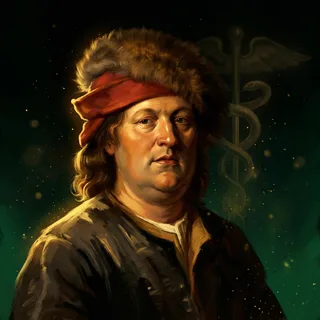
Paracelsus
Last updated: September 4, 2026
The physician-alchemist who shattered medieval medicine by insisting that God's secrets were written in the book of nature itself.
Lived
1493 – 1541
Nationality
Swiss-German
Tradition
Hermeticism
Known For
Numerous medical and alchemical treatises
Tone
Shadow-Leaning4 / 6
Alchemical-medical tradition dealing with poisons, elemental spirits, and the healing/harm boundary. Brash and confrontational.
Why Paracelsus Matters
Paracelsus didn't just practice alchemy, he lived it as a complete worldview where spirit and matter were one. He demolished the dusty theories of ancient authorities by declaring that true knowledge comes from direct observation of nature's hidden powers. His integration of chemical medicine with esoteric philosophy created the template for all later Western occultism. Without Paracelsus, there would be no scientific revolution, no Romantic mysticism, and no modern alternative medicine.
Start Here: The Reading Path
- Of the Supreme Mysteries of Nature1530His most systematic exposition of how the three philosophical principles (salt, sulfur, mercury) govern all natural phenomena. Start here to grasp his foundational worldview before diving into specific applications.Focus on the opening sections on the three principles rather than getting lost in the detailed mineral descriptions.
- Concerning the Spirits of the Planets1531A compact work showing how celestial influences operate through chemical processes in the human body. Essential for understanding his medical astrology and the doctrine of signatures.
- The Archidoxes of Magic1524His clearest statement on practical occult medicine and the relationship between macrocosm and microcosm. Read this to see how he unified theoretical knowledge with therapeutic practice.
Core Ideas in 60 Seconds
- The dose makes the poisonAll substances are potentially healing or harmful depending on quantity and application, establishing the fundamental principle of toxicology.Alchemy
- Nature is the physician, not youTrue healing comes from understanding and cooperating with natural processes rather than imposing artificial theories.Vitalism
- Man is a microcosm of the universeEvery process occurring in the cosmos also occurs within the human body, making astrology and alchemy keys to medicine.Microcosm
- The astral body is the link between spirit and fleshAn invisible vehicle that transmits celestial influences to the physical body and can be worked upon by the physician-magician.Astral Body
- Chemistry is the key to unlocking nature's secretsLaboratory work reveals the hidden properties of substances and their spiritual correspondences.As Above So Below
Major Works
| Title | Year | What It Teaches | Best For |
|---|---|---|---|
| Paramirum | 1529 | The five pillars of medicine: natural philosophy, astronomy, alchemy, ethics, and divine providence. | Advanced readers seeking his complete medical philosophy |
| Of the Supreme Mysteries of Nature | 1530 | How the three philosophical principles govern all natural phenomena and their medical applications. | Beginners to his alchemical worldview |
| The Archidoxes of Magic | 1524 | Practical methods for preparing spagyric medicines and understanding planetary influences on health. | Practitioners interested in occult medicine |
| Concerning the Spirits of the Planets | 1531 | How celestial bodies influence human physiology through chemical processes. | Students of medical astrology |
Lineage & Influence
Influenced By
He claimed direct inspiration from Hermes Trismegistus and drew heavily from the alchemical works attributed to Ramon Llull, though he rejected most medieval authorities in favor of direct observation.
Influenced
His chemical philosophy shaped Agrippa von Nettesheim's systematic magic, and his medical reforms influenced generations of iatrochemists. Later figures like Rudolf Steiner and Franz Bardon built their anthroposophical and hermetic systems on Paracelsian foundations.
Parallel Thinkers
Giordano Bruno developed parallel ideas about the unity of matter and spirit in the same period, though Bruno focused more on cosmology while Paracelsus emphasized practical medicine and laboratory work.
The Story
Born Philippus Aureolus Theophrastus Bombastus von Hohenheim in a Swiss mining village, he adopted the name Paracelsus to signal his ambition to surpass the ancient physician Celsus. After studying at universities across Europe, he became disgusted with book learning and burned the works of Galen and Avicenna, declaring that nature itself would be his teacher. He spent years wandering through mining regions, learning the secrets of metals and minerals from craftsmen, while developing a revolutionary approach to medicine based on chemical remedies rather than herbal mixtures. His confrontational personality and radical teachings earned him enemies throughout the medical establishment, forcing him to live as an itinerant physician and alchemist. Yet his insistence that experience trumped authority, and his successful treatments of previously incurable diseases, gradually won him followers who would transform both medicine and esoteric philosophy.
In Their Own Words
The dose makes the poison.
Third Defense
Nature is the physician, not you. From her learn, not from yourself.
Paramirum
All things are poison, and nothing is without poison; the dosage alone makes it so a thing is not a poison.
Third Defense
The art of healing comes from nature, not from the physician. Therefore the physician must start from nature, with an open mind.
Das Buch Paragranum
Frequently Asked Questions
What is Paracelsus famous for in medicine?
Paracelsus revolutionized medicine by introducing chemical remedies, establishing the principle that 'the dose makes the poison,' and insisting on direct observation of nature rather than relying on ancient authorities. He founded the field of toxicology and pioneered the use of specific chemicals to treat specific diseases.
Did Paracelsus really invent the concept of the astral body?
While earlier traditions spoke of subtle bodies, Paracelsus was the first to systematically describe the astral body as a specific vehicle that mediates between spirit and flesh, carries the imprint of celestial influences, and can be affected by magical operations. This concept became central to all later Western occultism.
Why did Paracelsus burn medical books?
He burned the works of Galen and Avicenna to dramatically reject the medieval practice of learning medicine from ancient texts rather than direct observation. His famous declaration was that one should learn from nature itself, not from books written by long-dead authorities.
How did Paracelsus combine alchemy with medicine?
Paracelsus created 'spagyric' medicine by using alchemical processes to extract the active principles from natural substances. He believed that laboratory work revealed the hidden correspondences between earthly materials and celestial influences, making alchemy essential for preparing effective remedies.
Explore Further
The Master Key Experience
The books teach the law.
The Experience trains it.
A 24-week guided journey through the laws of mind: weekly gates, lessons drawn from the texts in this library, and a living companion that remembers you.
Begin the ExperienceFree · Begin without an account