
Table of ContentsRalph Waldo Emerson
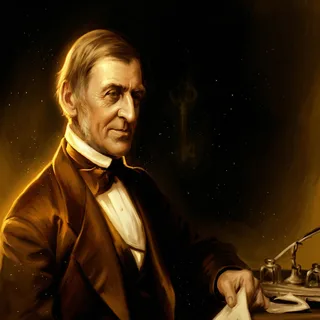
Ralph Waldo Emerson
Last updated: September 4, 2026
The Concord sage who taught America that God lives in every person and that thinking makes it so.
Lived
1803 – 1882
Nationality
American
Tradition
Transcendentalism
Known For
Nature (1836), Self-Reliance (1841), The Over-Soul (1841)
Tone
Balanced3 / 6
High-minded self-reliance; austere and bracing rather than cozy or dark.
Why Emerson Matters
Emerson didn't just write philosophy: he created the intellectual foundation for America's spiritual independence. His radical idea that divinity dwells within each individual, not in distant churches or creeds, liberated an entire generation from European theological authority. Every New Thought teacher from Trine to Holmes stands on his shoulders. When Emerson declared the soul's direct access to universal truth, he wasn't being poetic but prescriptive: he was teaching Americans how to become their own spiritual authorities.
Start Here: The Reading Path
- Nature1836Start here to understand Emerson's foundational insight: that the natural world is a perfect symbol system for spiritual truth. The famous transparent eyeball passage reveals his core method of spiritual perception.Read Chapter 4 on Language first to grasp his theory of correspondence before diving into the mystical sections.
- Self-Reliance1841The most practical application of his philosophy, showing how trust in your inner voice becomes a spiritual discipline. Essential for understanding how individual intuition connects to universal wisdom.
- The Over-Soul1841His most mystical essay, explaining how individual consciousness participates in a universal mind. This is where New Thought found its theological justification for mental causation.
Core Ideas in 60 Seconds
- There is one mind common to all individual menIndividual consciousness is not separate but participates in a universal intelligence that connects all beings.Universal Mind
- The laws of moral nature answer to those of matter as face to face in a glassSpiritual and physical laws operate by the same principles, making the universe a unified system of correspondence.Correspondence Law of
- Nothing can bring you peace but yourselfTrue spiritual authority comes from within, not from external institutions or teachings.Self-Realization
- We are all inlets to the same and to all of the sameEach person is a unique point of access to universal truth and divine wisdom.Unity
Major Works
| Title | Year | What It Teaches | Best For |
|---|---|---|---|
| Nature | 1836 | How to read the natural world as a book of spiritual instruction and correspondence. | Beginners seeking to understand Emerson's foundational worldview |
| Self-Reliance | 1841 | How to trust your intuitive faculty as a direct channel to universal truth. | Anyone struggling with spiritual authority or decision-making |
| The Over-Soul | 1841 | The metaphysical basis for individual connection to universal consciousness. | Advanced readers interested in mystical philosophy and consciousness studies |
Lineage & Influence
Influenced By
Emanuel Swedenborg's doctrine of correspondence provided Emerson with his method for reading spiritual truth in natural phenomena, while German Idealists like Kant gave him the framework for transcendental knowing beyond sensory experience.
Influenced
Ernest Holmes built Religious Science directly on Emerson's Over-Soul concept, while Ralph Waldo Trine popularized his ideas about the divinity within for the mass New Thought audience.
Parallel Thinkers
Thomas Carlyle shared his belief in the spiritual significance of nature and individual genius, though Carlyle emphasized heroic leadership while Emerson focused on democratic spiritual potential accessible to all.
The Story
Ralph Waldo Emerson began as a Unitarian minister in Boston but found himself unable to perform communion because he couldn't believe in its literal truth. This crisis of faith led him to resign his pulpit in 1832 and travel to Europe, where encounters with Romantic poets and German philosophy showed him a new path: direct spiritual experience without institutional mediation. Returning to Concord, he developed his philosophy of Transcendentalism through lectures and essays that taught Americans to find God in nature, in themselves, and in their own intuitive wisdom. His Concord home became the intellectual center of American spiritual independence, where Thoreau, Margaret Fuller, and other seekers gathered to explore what it meant to live from the soul rather than from convention. Emerson's greatest achievement was not any single insight but his creation of a distinctly American spirituality that valued individual revelation over inherited doctrine, preparing the ground for every metaphysical movement that followed.
In Their Own Words
Standing on the bare ground, my head bathed by the blithe air and uplifted into infinite space, all mean egotism vanishes. I become a transparent eyeball; I am nothing; I see all; the currents of the Universal Being circulate through me.
Nature
Trust thyself: every heart vibrates to that iron string.
Self-Reliance
The soul in man is not an organ, but animates and exercises all the organs; is not a function, like the power of memory, of calculation, of comparison, but uses these as hands and feet; is not a faculty, but a light; is not the intellect or the will, but the master of the intellect and the will; is the background of our being, in which they lie.
The Over-Soul
Frequently Asked Questions
What is Emerson's Over-Soul and how does it relate to New Thought?
The Over-Soul is Emerson's term for the universal mind or consciousness that connects all individual souls. New Thought teachers like Ernest Holmes used this concept to explain how individual mental states can affect universal conditions through their participation in this shared divine mind.
How did Emerson influence the Law of Attraction?
Emerson taught that thoughts are forces that attract corresponding experiences, writing that we become what we think about most. His doctrine of correspondence suggested that inner states manifest as outer conditions, providing the philosophical foundation for later Law of Attraction teachings.
Why did Emerson leave the ministry?
Emerson resigned from his Unitarian pulpit because he could no longer perform communion with genuine belief in its literal significance. This crisis led him to seek a more direct, personal form of spiritual experience that became the foundation of his Transcendentalist philosophy.
What makes Emerson different from other Transcendentalists?
While other Transcendentalists like Thoreau focused on social reform or practical living, Emerson concentrated on developing a complete philosophy of spiritual individualism. His emphasis on the divinity within each person provided the theological framework that later New Thought movements adopted and systematized.
Explore Further
Related Authors
The Master Key Experience
The books teach the law.
The Experience trains it.
A 24-week guided journey through the laws of mind: weekly gates, lessons drawn from the texts in this library, and a living companion that remembers you.
Begin the ExperienceFree · Begin without an account