
Table of ContentsW.W. Westcott
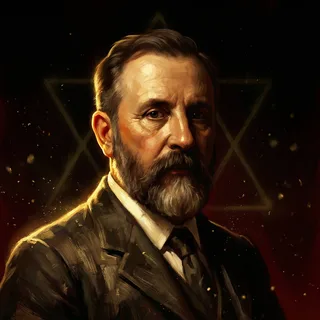
W.W. Westcott
Last updated: September 4, 2026
Westcott was the meticulous architect of modern ceremonial magic, providing the intellectual rigor and Kabbalistic framework that birthed the Golden Dawn and shaped subsequent occult traditions.
Lived
1848 – 1925
Nationality
British
Tradition
Ceremonial Magic
Known For
The Sepher Yetzirah (translation, 1887), An Introduction to the Study of the Kabalah (1910), Numbers: Their Occult Power and Mystic Virtues (1890)
Tone
Shadow-Leaning4.5 / 6
Co-founder of the Golden Dawn alongside Mathers. Translated Sepher Yetzirah and compiled the Cipher Manuscripts. Ceremonial magic framework with angelic and elemental hierarchies. Scholarly and systematic, similar intensity to Mathers.
Why Westcott Matters
William Wynn Westcott is indispensable for understanding the foundations of modern Western esotericism. While often overshadowed by his more charismatic co-founders, Westcott's scholarly dedication, particularly to Kabbalah, and his administrative genius were the bedrock upon which the Hermetic Order of the Golden Dawn was built. His translations and commentaries made complex esoteric systems accessible to a wider English-speaking audience, directly influencing generations of magicians and occultists. Without Westcott's meticulous work, the Golden Dawn's structured magical system, and much of what followed, would likely not exist in the form we know it.
Start Here: The Reading Path
- The Sepher Yetzirah (translation)1887This is Westcott's foundational translation of a pivotal Kabbalistic text. It offers insights into the creation of the universe through numbers, letters, and sounds, a core concept in Western esotericism.Read the introduction carefully. Westcott's commentary provides crucial context for understanding the philosophical underpinnings of his magical system.
- Numbers: Their Occult Power and Mystic Virtues1890Explore the symbolic and magical significance of numbers, a concept central to Kabbalah and ceremonial magic. Westcott systematically outlines how numbers relate to cosmic principles and human experience.This work illuminates the numerological basis for many Golden Dawn rituals and symbols. It helps demystify the 'why' behind certain correspondences.
- An Introduction to the Study of the Kabalah1910A concise yet comprehensive overview of Kabbalistic principles, designed to initiate the serious student into this complex tradition. Westcott distills key concepts, making them approachable.Consider this a primer before diving deeper into more intricate Kabbalistic texts. It provides a map for the Tree of Life and its associated ideas.
Core Ideas in 60 Seconds
- Kabbalah is the essential framework for understanding divine manifestation and human spiritual ascent.Westcott believed that the Kabbalah, particularly the Tree of Life, provided a map of the cosmos and the human soul, offering a systematic path for magical and spiritual development.Kabbalah
- Numbers possess inherent occult power and mystic virtues, reflecting universal principles.He posited that numbers are not merely quantities but symbols imbued with energetic and qualitative significance, revealing the structure of reality and the divine mind.
- Ceremonial magic, when properly executed, is a scientific application of esoteric principles for spiritual transformation.Westcott viewed ritual as a precise method to align the microcosmic self with macrocosmic forces, facilitating inner and outer change.Magick
- The Hermetic tradition offers a unified system of knowledge encompassing philosophy, religion, and magic.He saw Hermeticism as the ancient source of a synthetic wisdom tradition, integrating diverse esoteric currents into a coherent whole.Hermetic Principles
Major Works
| Title | Year | What It Teaches | Best For |
|---|---|---|---|
| The Sepher Yetzirah (translation) | 1887 | This translation and commentary introduces the foundational Kabbalistic text on creation through letters and numbers. | Students seeking the Kabbalistic roots of Western esotericism and the Golden Dawn system. |
| Numbers: Their Occult Power and Mystic Virtues | 1890 | It explores the symbolic and magical significance of numbers across various esoteric traditions. | Those interested in numerology, Gematria, and the numerical correspondences within magical systems. |
| An Introduction to the Study of the Kabalah | 1910 | This work provides a clear and concise overview of Kabbalistic philosophy and its practical applications. | Beginners to Kabbalah who need a structured and accessible entry point. |
| The Isiac Tablet of Cardinal Bembo | 1887 | A scholarly analysis of an ancient Egyptian-style bronze tablet, interpreting its symbols through Hermetic and Kabbalistic lenses. | Researchers interested in the syncretic nature of Hermetic symbolism and its historical interpretations. |
Lineage & Influence
Influenced By
Westcott drew heavily from earlier European esotericists like Eliphas Levi, whose synthesis of Kabbalah and magic provided a template, and from Kenneth Mackenzie, a fellow Rosicrucian and Masonic scholar who shared a deep interest in occult societies and their hidden knowledge.
Influenced
His work directly shaped the Hermetic Order of the Golden Dawn, providing its intellectual backbone and ritual structure, thereby influencing virtually all subsequent modern ceremonial magic practitioners, including figures like Aleister Crowley and Dion Fortune.
Parallel Thinkers
He shared a contemporary interest in structured esoteric systems with S.L. MacGregor Mathers, his co-founder, and to some extent, with Arthur Edward Waite, who also sought to systematize and interpret Western esoteric traditions, though often with differing emphasis.
The Story
William Wynn Westcott, a London coroner by profession, was a man of profound scholarly inclination who found his true calling in the hidden currents of esotericism. Disillusioned with the superficiality of much contemporary occultism, he immersed himself in ancient texts, meticulously translating and interpreting works of Kabbalah and Hermetic philosophy. His administrative acumen and intellectual rigor, combined with the discovery of the enigmatic Cipher Manuscripts, led him to co-found the Hermetic Order of the Golden Dawn alongside S.L. MacGregor Mathers and William Robert Woodman. Westcott became the quiet, steady hand behind the Order's complex grade system and ritual structure, providing the essential intellectual and organizational framework that allowed the Golden Dawn to become the most influential magical order of its time, shaping the landscape of modern ceremonial magic for generations to come.
In Their Own Words
The true Qabalah is a system of philosophy which embraces all knowledge.
An Introduction to the Study of the Kabalah
The Hebrew Qabalah is a system of Theosophy, or religious philosophy, which has come down to us from the ancient Jews, and which is still taught by the learned among them.
An Introduction to the Study of the Kabalah
The object of Occult Science is to obtain knowledge of the nature of the invisible world and to become acquainted with the action of the invisible forces.
Numbers: Their Occult Power and Mystic Virtues
Frequently Asked Questions
What was W.W. Westcott's role in the Golden Dawn?
Westcott was a co-founder of the Hermetic Order of the Golden Dawn. He primarily provided the intellectual and organizational framework, translating the Cipher Manuscripts and establishing the Order's structured grade system and ritualistic curriculum. He was the Supreme Magus of the Order's first temple.
How did Westcott contribute to the study of Kabbalah?
Westcott made significant contributions by translating and commenting on key Kabbalistic texts, most notably 'The Sepher Yetzirah,' making this complex system accessible to English-speaking occultists. His work helped integrate Kabbalah as a central pillar of Western ceremonial magic.
Was Westcott a practicing magician, or just a scholar?
While known for his scholarly rigor and administrative skills, Westcott was indeed a practicing magician within the Golden Dawn. He viewed ceremonial magic as a scientific application of esoteric principles, engaging in the rituals and practices he helped to codify.
Explore Further
The Master Key Experience
The books teach the law.
The Experience trains it.
A 24-week guided journey through the laws of mind: weekly gates, lessons drawn from the texts in this library, and a living companion that remembers you.
Begin the ExperienceFree · Begin without an account