
Table of ContentsIsaac Luria
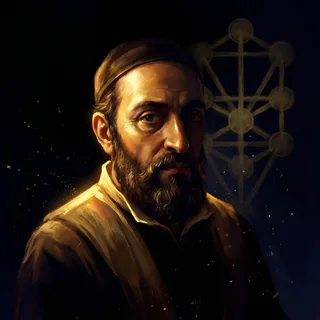
Isaac Luria
Last updated: September 4, 2026
Isaac Luria is not merely a historical figure; he is the architect of the Kabbalistic cosmos, whose visions of divine contraction and cosmic repair continue to shape Western esotericism and occult practice.
Lived
1534 – 1572
Nationality
Ottoman (Safed, Palestine)
Tradition
Kabbalah
Known For
Etz Chaim (recorded by Chaim Vital), Sha'ar HaGilgulim (Gate of Reincarnations), Sha'ar HaKavanot (Gate of Intentions)
Tone
Balanced3.5 / 6
Cosmic drama of tzimtzum and shattering, but the entire system motivates tikkun (repair). Darkness is setup, not destination.
Why Luria Matters
Luria, known as the Ari, fundamentally re-envisioned Kabbalah, providing a dramatic, narrative framework for understanding creation, exile, and redemption. His system, particularly the doctrines of Tzimtzum, Shevirat ha-Kelim, and Tikkun, offered a profound mystical cosmology that permeated Jewish thought and, crucially, became a cornerstone for later Western esoteric traditions, including Hermetic Qabalah. To understand the esoteric Tree of Life, one must grapple with Lurianic concepts.
Start Here: The Reading Path
- Etz Chaim (Tree of Life)1573This monumental work, compiled by Luria's chief disciple Chaim Vital, is the primary repository of Lurianic Kabbalah. It systematically lays out his entire cosmological scheme, from the initial act of divine contraction to the process of cosmic repair.Approach this text with patience and a good commentary. It is dense and requires careful study, but it is the definitive source for Lurianic thought.
- Sha'ar HaGilgulim (Gate of Reincarnations)1573Also recorded by Chaim Vital, this text delves into the Lurianic understanding of reincarnation (gilgul) and soul rectification. It explains how individual souls contribute to the larger cosmic Tikkun.Read this after gaining a basic understanding of Tzimtzum and Shevirat ha-Kelim from Etz Chaim, as it applies those principles to the individual human journey.
Core Ideas in 60 Seconds
- Creation began with divine self-limitation, not emanation.Before creation, the Infinite (Ein Sof) contracted itself (Tzimtzum) to make space for existence, leaving a primordial void.Tzimtzum
- The initial act of creation resulted in a cosmic catastrophe.The divine light, too intense for the vessels (Kelim) meant to contain it, caused them to shatter (Shevirat ha-Kelim), scattering sparks of divinity throughout creation.
- Humanity's purpose is to repair the shattered cosmos.Through mystical contemplation, ethical action, and adherence to divine commandments, individuals can gather the scattered sparks and restore the primordial harmony (Tikkun).Tikkun
- Every soul has a unique path of rectification and contributes to universal restoration.Souls undergo reincarnation (gilgul) to fulfill their specific tasks in the grand project of Tikkun, refining themselves and the world.Reincarnation
Major Works
| Title | Year | What It Teaches | Best For |
|---|---|---|---|
| Etz Chaim (Tree of Life) | 1573 | This work systematically outlines Luria's entire cosmological system, including Tzimtzum, Shevirat ha-Kelim, and Tikkun. | Serious students seeking a comprehensive understanding of Lurianic Kabbalah. |
| Sha'ar HaGilgulim (Gate of Reincarnations) | 1573 | It details the Lurianic doctrines of soul transmigration, rectification, and the role of individual souls in cosmic repair. | Those interested in the Kabbalistic understanding of reincarnation and personal spiritual evolution. |
| Sha'ar HaKavanot (Gate of Intentions) | 1573 | This text explains the specific meditative and prayer intentions (kavanot) used to facilitate Tikkun. | Practitioners seeking to understand the practical mystical applications of Lurianic thought. |
Lineage & Influence
Influenced By
Luria built upon the earlier Kabbalistic traditions, particularly the Zohar and the systematic approach of Moses Cordovero, synthesizing and dramatically reinterpreting their teachings into a dynamic, narrative cosmology.
Influenced
His teachings profoundly shaped subsequent Jewish mysticism and became a foundational source for Western esotericism, influencing figures like S.L. MacGregor Mathers, Aleister Crowley, and the Hermetic Qabalah tradition, which adopted and adapted his Tree of Life concepts.
Parallel Thinkers
While distinct, Luria's emphasis on cosmic fall and subsequent repair finds echoes in Gnostic traditions and later Theosophical concepts of involution and evolution, though his framework is uniquely Kabbalistic.
The Story
Born in Jerusalem in 1534, Isaac Luria, known as the Ari, was a figure of intense mystical devotion and intellectual prowess. After years of secluded study and ascetic practice in Egypt, he moved to Safed, then a vibrant center of Kabbalistic learning. There, for a brief but incandescent period of less than two years before his death in 1572, he unveiled a revolutionary new system of Kabbalah to a select group of disciples, most notably Chaim Vital. Luria himself wrote almost nothing, preferring to teach orally, but his students meticulously recorded his profound visions, creating a body of work that would forever alter the landscape of Jewish mysticism and, by extension, much of Western esoteric thought, providing a dramatic narrative of divine exile and human responsibility for cosmic restoration.
In Their Own Words
Every soul must fulfill its own tikkun.
Sha'ar HaGilgulim (Gate of Reincarnations)
The Ein Sof, blessed be He, restricted Himself in His essence, and drew back His light from that place, and then there was a vacant space, an empty void.
Etz Chaim (Tree of Life)
Frequently Asked Questions
What is the significance of Tzimtzum in Lurianic Kabbalah?
Tzimtzum, the divine contraction, is Luria's radical explanation for how a finite world could emerge from an infinite God. It posits that God 'withdrew' into Himself to create a primordial void, making space for creation without compromising His absolute omnipresence.
How did Luria's teachings influence Western esotericism?
Luria's complex cosmology, particularly his narrative of the shattering of vessels and the need for cosmic repair, provided a dramatic and influential framework for understanding the Tree of Life and the process of spiritual rectification. This deeply impacted Hermetic Qabalah, the Golden Dawn, and subsequent occultists who adopted and adapted his concepts for their own magical and mystical systems.
Did Isaac Luria write his own books?
No, Isaac Luria wrote almost nothing himself. His profound and complex teachings were meticulously recorded and compiled by his devoted student, Rabbi Chaim Vital, primarily in works such as Etz Chaim and Sha'ar HaGilgulim.
Explore Further
Related Authors
The Master Key Experience
The books teach the law.
The Experience trains it.
A 24-week guided journey through the laws of mind: weekly gates, lessons drawn from the texts in this library, and a living companion that remembers you.
Begin the ExperienceFree · Begin without an account