
What is Transmutation?
Last updated: July 12, 2026
The act of changing the nature or substance of something. In alchemy, converting base metals to gold; in metaphysics, elevating consciousness.
Understanding Transmutation in Alchemy
The act of changing the nature or substance of something. In alchemy, converting base metals to gold; in metaphysics, elevating consciousness.
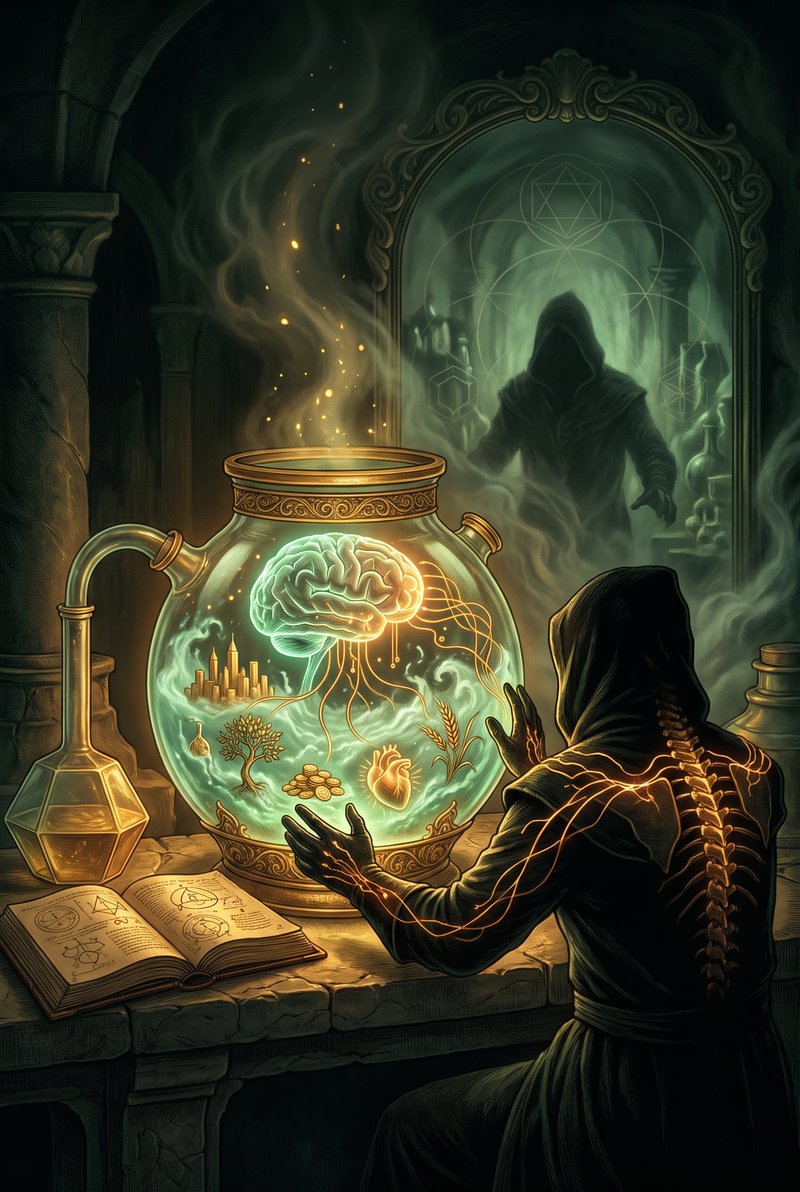
Transmutation, a cornerstone concept in alchemy, extends beyond the literal conversion of base metals into gold, representing a profound philosophical and spiritual process. Historically, alchemists sought not only material wealth but also spiritual purification and enlightenment, viewing the transformation of lead to gold as a metaphor for the soul's journey from an impure state to a perfected one. This principle underscores the belief that all things, including human consciousness, possess an inherent potential for elevation and refinement. Its significance lies in its holistic approach to change, influencing not just chemistry but also psychology and spiritual development across various esoteric traditions.
What the Teachers Say
Transmutation vs. Coagulation
While transmutation involves changing the essential nature of a substance, coagulation focuses on solidifying and fixing volatile materials. These processes often work together in alchemical operations, with transmutation providing qualitative change and coagulation providing stability.
| Aspect | Transmutation | Coagulation |
|---|---|---|
| Primary Action | Changes essential nature and properties | Stabilizes and solidifies existing properties |
| Direction of Change | Transforms one substance into another | Preserves substance while changing state |
| Symbolic Meaning | Represents spiritual evolution and perfection | Represents manifestation and material expression |
| Laboratory Process | Involves multiple dissolution and purification cycles | Focuses on precipitation and crystallization |
| Ultimate Goal | Achieves the philosopher's stone | Creates stable, permanent forms |
Etymology
The term "transmutation" originates from the Latin "transmutare," meaning "to change over" or "to change thoroughly." It is composed of "trans," meaning "across" or "beyond," and "mutare," meaning "to change." This etymological foundation precisely captures the essence of a fundamental shift or alteration, moving from one state or form to another, as understood in both its chemical and metaphysical contexts.
How to Practice This
In a practical sense, transmutation involves a disciplined approach to self-improvement and energetic redirection. Practitioners might engage in specific meditative practices to transform negative emotions, such as anger or fear, into constructive energies like determination or compassion. This can involve focused visualization, breathwork, and conscious redirection of internal states. For example, an individual might intentionally reframe a perceived failure as a learning opportunity, thereby transmuting discouragement into motivation for future endeavors.
Connection to Manifestation
Transmutation principles directly inform modern understanding of personal transformation and manifestation. Just as alchemists believed consciousness could transform base metals through focused intention and proper technique, contemporary practitioners apply transmutation concepts to change limiting beliefs into empowering ones. The alchemical emphasis on inner purification before outer transformation parallels the law of attraction teaching that internal states must shift before external circumstances can change. This connection makes transmutation a powerful metaphor for conscious creation, where persistent mental and emotional work gradually transforms one's entire life experience.
Frequently Asked Questions
Transmutation involves changing the fundamental essence or nature of something, while transformation typically refers to changes in form or appearance. In alchemy, transmutation specifically means converting one element or substance into another entirely different substance, such as lead into gold.
Modern nuclear physics has achieved atomic transmutation through particle accelerators and nuclear reactors, but not through traditional alchemical methods. Historical alchemists may have achieved some chemical transformations through metallurgical techniques, but true elemental conversion requires nuclear-level processes unknown to ancient practitioners.
Alchemists viewed metal transmutation and spiritual transmutation as parallel processes governed by the same universal principles. The transformation of base metals into gold symbolically represented the purification of the human soul and the achievement of spiritual perfection.
The philosopher's stone serves as the catalyst or agent that enables transmutation of base metals into gold. It represents both a physical substance capable of metallic transformation and a spiritual achievement symbolizing the perfected human consciousness.
Many modern practitioners adapt alchemical transmutation concepts for personal growth, viewing negative emotions and limiting beliefs as 'base metals' to be transformed into wisdom and empowerment. This approach emphasizes gradual purification through persistent inner work and conscious application of transformative principles.
In the Source Texts (9)
…stigation shows that the physical body is a mechanism specially adapted for the transmutation of the inner or mental power into modes of external activity. We know from medical science that the whole body is traversed by a network of…
…rendered Soft. Dull things become Sharp. Hot things become Cold. And so on, the transmutation always being between things of the same kind of different degrees. Take the case of a Fearful man. By raising his mental vibrations along t…
…the lower, escaping the pains of the lower planes by vibrating on the higher. ~Transmutation, not presumptuous denial, is the weapon of the Master.~<<…
Explore Further
Used by: Charles F. Haanel
The Master Key Experience
The books teach the law.
The Experience trains it.
A 24-week guided journey through the laws of mind: weekly gates, lessons drawn from the texts in this library, and a living companion that remembers you.
Begin the ExperienceFree · Begin without an account